Tuesday, August 29, 2017

Tuesday Tome - The Good Book

Starting in September, our church will be using this book for an intergenerational class (High School students and older) on Sunday mornings, 9:00am. Brad Dewing, our associate pastor of youth and family ministry will be teaching the class.


https://smile.amazon.com/Good-Book-Chapters-Reveal-Biggest/dp/0781414415/ref=sr_1_1?s=books&ie=UTF8&qid=1499797930&sr=1-1&keywords=The+Good+BOokTHE GOOD BOOK
by Deron Spoo

Publisher's Description...
The Good Book offers a user-friendly guide to the Bible's biggest ideas. A chapter from the Bible accompanies each chapter of the book, which helps readers understand the context and content of the Scripture passages in a way that can open the whole Bible.

Designed as a forty-day journey through forty key chapters of the Bible, The Good Book will appeal to those who already love and read the Bible regularly as well as to those who are just beginning their Christian journey.

ORDER YOUR COPY FROM AMAZON

Monday, August 28, 2017

Monday Music - Bruce Cockburn: States I'm In

https://youtu.be/LXN3i8S9Xbo 
CLICK HERE OR ON IMAGE

The first single off of Bruce Cockburn's latest release "Bone On Bone" from True North Records.

Pre-order 'Bone On Bone' now:
True North: http://bit.ly/2ufirbM
iTunes: http://apple.co/2ufrV6y
Amazon: http://amzn.to/2v9ynsh

Sunday, August 27, 2017

Sunday Supplication - Things that Last Forever

O Lord, help us to not to be stressed out over earthly troubles, but, instead trust that you will see us through. Even now, as we live among things that are passing away, help us to hold on to the things that last forever.

We confess our sins and we thank you for your faithfulness to forgive us and purify us. And as your grateful children, teach us and help us to be faithful to forgive others. May the grace of Jesus help us restore relationships, heal wounds, calm fears, forgive offenses, and resolve conflicts.

O God, help us find our life and meaning and purpose in Jesus. We desire to surrender to him more and more. Give us the wisdom and the will to submit ourselves to you as we follow Him.

It’s in his name that we pray these things. Amen.

Thursday, August 24, 2017

Thurs Thinking - Formation before Interpretation


Cultivating the Practice of Reading Scripture
by Joel B. Green

While teaching at a conference some years ago, I was startled when a participant announced that he could not imagine how any Republican could claim to take the Bible seriously. Not long afterward, I witnessed a repeat performance in another setting, except in this case we were told that Republicans alone read Scripture correctly. This reminds me of what I imagine to be a first-century “battle for the Bible”: Pharisees, Christ-followers, and Sadducees, all reading the same Scriptures but reading them quite differently, and reaching diverse conclusions about the nature of faithfulness to God. How can this be?

Clearly, a lot has to do with our formation as readers of Scripture and not only with the words written on the page. This underscores the importance of reading Scripture as a “practice,” since the idea of “practice” assumes circularity: Formed by our reading of Scripture, we become better readers of Scripture. This is not because we become better skilled at applying biblical principles. The practice of reading Scripture is not about learning how to mold the biblical message to contemporary lives and modern needs. Rather, the Scriptures yearn to reshape how we comprehend our lives and identify our greatest needs. We find in Scripture who we are and what we might become, so that we come to share its assessment of our situation, encounter its promise of restoration, and hear its challenge to serve God’s good news.

Paradoxically, perhaps, cultivating the practice of reading Scripture first prioritizes Christian formation more generally. This is because there is no necessary, straight line from reading the biblical materials to reading them Christianly; sharply put, one can be “biblical” without being “Christian.”

When Jesus criticizes two disciples on the Emmaus Road for their failure to believe what the prophets had spoken, the problem was not their inability to hear the prophets or take them seriously. Jesus asked, “Wasn’t it necessary for the Christ to suffer these things and then enter into his glory?” (Luke 24:27 CEB). “Of course it was necessary!” we might say, but the question remains, which prophets actually document this necessity? “Isaiah 53,” we might respond, but we would then need to acknowledge that we can say this only because we have learned to read in just this way. After all, Isaiah 53 never mentions the Messiah, and Jesus’ contemporaries were unaccustomed to thinking of Isaiah’s Servant as a suffering Messiah. The problem faced by Jesus’ disciples was their lack of the cognitive categories required for making sense of the Scriptures in this way. They needed more than a commonsense reading of a biblical text. That Isaiah spoke of Jesus was something they had to learn. Accordingly, Luke records: “Then he interpreted for them the things written about himself in all the scriptures.” (Luke 24:27 CEB).

This example speaks to the integrated nature of Christian practices, and especially to the ways those practices shape us as readers of Scripture. Christian formation helps us to read the Scriptures Christianly. So it is worth reflecting on the difference it makes to our reading of Scripture that we regularly recite the Apostles’ Creed. What difference does it make to our reading of Scripture that we meet each other repeatedly at the Lord’s Table, that we speak often with people who do not share our faith, that we who share a common faith in Christ eat together regularly, and that we pray to Jesus as though he were God? (And what difference does it make when we do not engage in such practices as these?)

Of course, reading Scripture is itself a central Christian practice, so we may ask how we cultivate this practice among the others—a question I take up more fully in Seized by Truth: Reading the Bible as Scripture (Abingdon, 2007). Here let me make six suggestions.

(1) Reading Scripture is not enough. Theological and ecclesial formation inform and are informed by reading Scripture. Communities that put Scripture into practice through seeking the Holy Spirit, confessing sins and forgiving each other, praying for the sick, and offering good news to others find themselves being prepared to read Scripture.

(2) Read and read again. It is easy to turn time with Scripture into a game of “Twenty Questions”: how to have a happy relationship, learn nancial faithfulness, or whatever. A sharp line can be drawn between utilitarian approaches that treat the Bible as a how-to manual or a database for addressing my questions, and the formation of Scripture-shaped minds that understand God and God’s creation through Scripture-shaped lenses. The latter requires patient, deliberate reading—reading, as it were, for no good reason but for the sake of having our dispositions and re exes shaped by Scripture.

(3) Read slowly. Those of us who find ourselves moving back and forth between blogs, email, texts, news outlets, and social networks on our smartphones and tablets need different rules of engagement for reading Scripture. This practice concerns not how fast I can get through today’s reading, but how slowly, combining prayer, reading, and contemplation. To crib Jesus’ words, “Let these words sink into your ears” (Luke 9:44 NRSV).

(4) Involve yourself. If the last century or more has imagined education as the process of stepping back to observe, assess, and attain knowledge, then this practice calls for different habits. This learning is self-involving, a means by which we hear God’s address. Why do we resist this text but embrace that one? What does it mean that we are included in the community of God’s people addressed by this text?

(5) Read together. Inasmuch as scriptural texts have their origins and purpose deeply rooted in the community of God’s people, we ought to nd ways to read in community. By this I refer to the importance of study groups where our assumptions and views are tested, but even more I mean to counter the temptation to imagine that Scripture is simply for me and about me, or that I am tasked with determining its significance apart from the larger church, historically and globally.

(6) Refuse to distinguish between reading the Bible for a class or sermon and reading the Bible for Christian formation. We come to Scripture for different reasons at different times, but it would be a mistake to imagine that preparing an exegesis paper or sermon required qualitatively different protocols. Should we leave our theological and ecclesial locations behind when doing exegesis? Should work with Scripture in sermon preparation bypass the reservoir of my regular reading practices? Should the crises that arise as I encounter God’s voice in Scripture not shape my reading of these texts with and for others?

As with Christian practices in general, so with developing scriptural patterns of faith and life: the destination is the journey itself. This is a journey in which we discover that the work of scriptural reading is not about transforming an ancient message into a modern application but about the transformation of our lives though Scripture. The Bible does not present us with texts to be mastered, then, but with a Word intent on shaping our lives, on mastering us.

This article published at Catalystresources.org.

Wednesday, August 23, 2017

Wednesday Words - A Barred Owl

The warping night air having brought the boom
Of an owl's voice into her darkened room,
We tell the wakened child that all she heard
Was an odd question from a forest bird,
Asking of us, if rightly listened to,
"Who cooks for you?" and then "Who cooks for you?"

Words, which can make our terrors bravely clear,
Can also thus domesticate a fear,
And send a small child back to sleep at night
Not listening for the sound of stealthy flight
Or dreaming of some small thing in a claw
Borne up to some dark branch and eaten raw.

by Richard Wilbur, from Collected Poems: 1943-2004.
© Houghton Mifflin, 2006.

Tuesday, August 22, 2017

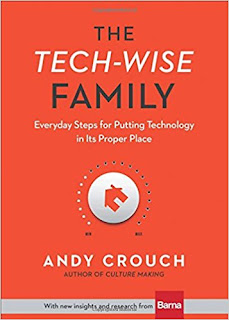
Tuesday Tome - Tech-Wise Families

I'm posting this book again this week since my associate pastor, Brad Dewing, recommended it to all youth parents at a lunch gathering after church yesterday. Brad says it's every bit as much about family as it is about tech. So let's read it!

https://smile.amazon.com/gp/product/0801018668/ref=oh_aui_detailpage_o00_s00?ie=UTF8&psc=1
The Tech-Wise Family: Everyday Steps for 
Putting Technology in Its Proper Place 
by Andy Crouch

Publisher's description...
Making conscientious choices about technology in our families is more than just using internet filters and determining screen time limits for our children. It's about developing wisdom, character, and courage in the way we use digital media rather than accepting technology's promises of ease, instant gratification, and the world's knowledge at our fingertips. And it's definitely not just about the kids.

Drawing on in-depth original research from the Barna Group, Andy Crouch shows readers that the choices we make about technology have consequences we may never have considered. He takes readers beyond the typical questions of what, where, and when and instead challenges them to answer provocative questions like, Who do we want to be as a family? and How does our use of a particular technology move us closer or farther away from that goal? Anyone who has felt their family relationships suffer or their time slip away amid technology's distractions will find in this book a path forward to reclaiming their real life in a world of devices.

Sunday, August 20, 2017

Sunday Supplication - Guide Us in All Ways

O God, we need your help to be the people you want us to be. We ask your Holy Spirit to be at work in our lives to transform us and guide us in all ways. Help us to trust you with all our hearts.

Forgive us our sins. Help us to leave the darkness and love the light. Make us willing and able to forgive others as you have forgiven us. Help us to think, speak, and act in ways that restore lives, nurture relationships, create peace, and bring honor to you.

Help us, O Lord, to be good stewards of all you have given us. Grant us the wisdom and the will to guard our hearts, feed our spirits, stimulate our minds, and care for our bodies. And help us, by faith, to do the good things you've prepared in advance for us to do.

Through Christ, we pray. Amen.

Friday, August 18, 2017

Friday Favorites - Hidden Falls Park

Hidden Falls Park - St. Paul, MN

I just discovered this amazing park this summer. It is a quiet sprawling park with beautiful scenery, great trails, wonderful picnic sites, and good fishing with a boat launch.

Thursday, August 17, 2017

Thursday Thinking - Race and Grace

Revelation 5:9
9 And they sang a new song: "You are worthy to take the scroll and to open its seals, because you were slain, and with your blood you purchased men for God from every tribe and language and people and nation.

In John’s vision he sees the Lamb who was slain surrounded by the elders and the four living creatures as they worship him. The Lamb, they sing, is worthy of praise and worship because he laid down his life to save people from every people group. God's intention and plan is to save people from every people group. Jesus’ sacrifice was made for people of every race, ethnicity, nation, and language. God so loved the world that he sent his only Son that whoever believes in him might have eternal life.

Those who walk in the way of Christ must remember that his love and sacrifice are for all people. God's heart is benevolent toward all people regardless of ethnicity and culture. Those whose hearts are being led and shaped by the Spirit will also have good will toward all people, regardless of ethnicity and culture.

Let us raise our voices in praise to God for the salvation and hope he offers to all humanity through Christ. Let us also join God's redemptive intention and work for the blessing and salvation of all people whatever their race or nation of origin.

Acts 10:34-35
34 Then Peter began to speak: “I now realize how true it is that God does not show favoritism 35 but accepts from every nation the one who fears him and does what is right.

Wednesday, August 16, 2017

Wednesday Words - August

When the blackberries hang
swollen in the woods, in the brambles
nobody owns, I spend

all day among the high
branches, reaching
my ripped arms, thinking

of nothing, cramming
the black honey of summer
into my mouth; all day my body

accepts what it is. In the dark
creeks that run by there is
this thick paw of my life darting among

the black bells, the leaves, there is
this happy tongue.

"August" by Mary Oliver, from American Primitive, © Copyright 1983 by Mary Oliver.